Showing posts with label rap. Show all posts

Monday, 25 March 2013

Question 7 - Looking back at your preliminary task, what do you feel you have learnt in the progression from it to the full product?

Evaluation

Looking back at your preliminary task, what do you feel you have learnt in the progression from it to the full product?

To begin my answer to this question, I have made a slideshow on Microsoft Office PowerPoint, to demonstrate the development of my product throughout the process, and uploaded it using my account on SlideShare. The slideshow can be found here: Looking back at your preliminary task, what do you feel you have learnt in the progression from it to the full product?

The progress I have made from my preliminary product, the College Magazine, to my final piece, the Music Magazine, is huge. I have improved my abilities when using certain software and learnt new skills to apply to my media coursework as a whole. I will break the long process of my media product down in to four sections: research, planning, production and evaluation.

Research

For my preliminary product, absolutely no research was carried out. I did not know anything about the conventions of similar media products. Mise-en-scene was something I had little knowledge regarding. I also had no clues as to what a media institution was and what publishers existed. To sum up, I made my preliminary product based solely on my own ideas and it was far from an informed production. For my final piece, the research was meticulous. I researched the covers, contents and double page spreads of other media products from magazines such as 'NME', 'Q!' and 'Rolling Stone', gaining extremely valuable knowledge about the conventions of similar products. I learnt what props, models and locations I should use for the mise-en-scene of my final piece. I looked in to media institutions such as Bauer Media and IPC Media, picking up quantitative and qualitative information on the industry, other music magazines and their publishers. I found out a lot of statistics from the NRS (National Readership Survey) and also the college media packs, more quantitative data. I then used a filmed interview and SurveyMonkey to collect and collate quantitative information on what people would want from my magazine. I posted all my research on blogger, allowing me to find whatever I want as want when needed during the process of making the magazine.As you can see, my research was of such a level that already I was starting miles ahead of my preliminary product in terms of product knowledge.

Planning

For my preliminary magazine there was again very little planning. My planning effectively occurred as I started working on the final piece. This meant the production of the product took a lot longer than it really should have done. When it came to my final piece, I had done a lot more planning. I drafted up flat plans of my front cover, contents and double page spread. These flat plans gave me the layout and format for all of my final pieces, showing the positioning of headings, mastheads, coverlines, images and text. This meant producing my final pieces was a lot simpler and caused a lot less stress. I drew up a detailed photography plan which detailed how many photos I was going to take, where they would be taken, who they would be taken of and what props, if any, would be used. This is a stark contrast to my preliminary piece where I experimented with different models and my ideas in terms of location were lacking thought. I wrote a pitch outlining the key features of my magazine, including pricing, audience, name, genre and other things and presented it to my class, who then gave me both positive feedback and constructive criticism, giving me vice for product development. I also wrote out the script for my double page spread interview in advance.

Production

When starting the production of my preliminary product, I had extremely limited skills on Adobe Photoshop and my product was poorly produced all things considered. When coming around to my final piece, I had much better skills in Photoshop thanks to the practise my preliminary product gave me and was able to perform in a more accomplished manner, performing more advanced operations such as pixel editing, using the magnetic cutout, using the spray can tool and this time carefully altering the levels and colour balance rather than in my preliminary product where the colours were rather unrealistic and became pixelated. The big changes from preliminary to final were most noticeable in my contents pages. For my preliminary product, my contents page was effectively a poor flat plan, produced in Microsoft Publisher, due to my limited Photoshop skills. For my final piece, my contents page was produced on Photoshop and using ideas such as rule of three and maintaining the house style of my magazine, I was able to bring together a much more advanced contents page. In the images used on my cover, contents and double page spread, there was evidence of my newly found knowledge of mise-en-scene. Another improvement in my production, thanks to my research, was the demonstration of media conventions across all three pieces. I styled the mise-en-scene of my models' on other magazines' models from similar genres. You can also see that the coverlines and masthead are positioned in a similar way to that 'Rolling Stone' magazine, a magazine from which a front cover I studied had a rapper on the front, thus giving me a model to base my cover on. I used ideas taken from the contents and double page spreads of 'NME', 'Q!' and 'Rolling Stone' to influence my own, but still managed to create an original style using a unique house style of blue and gold text. I decided on my colour scheme by matching contrasting colours on Photoshop, a much more advanced method than when I just plucked colours I felt would work for my preliminary piece. In regards of fonts, I got all of my fonts for both my final and preliminary pieces from dafont.com, perhaps one of the few things I didn't advance in from my preliminary piece to my final. Intriguingly, I inadvertently used the same fonts for my masthead in both pieces. This did not occur to me until after I had finished my final piece and compared the two for this question. I do, however, think the fonts used in my final piece are better matched than they were in my preliminary piece. As well as producing my product, I have produced many articles on my blog, documenting my progress and when I finished producing each article, I used the spellcheck tool to check my spelling.

Evaluation

Overall, I think I had a varied experience completing my coursework and made huge leaps from my preliminary piece to my final piece. I think I managed to convey the conventions of similar media products very well in my final piece, which is a big difference from my preliminary piece in which I followed no conventions at all. I think my improvements in Adobe Photoshop made a huge difference to the quality of my final piece in contrast with my preliminary and were arguably the biggest change between the two pieces. I definitely think my final piece has a lot more substance than my preliminary and when you pick beneath the initial image and words you can see the research and planning really come to light. In terms of improvements on my final piece, I think I could varied the fonts a lot more as throughout my final piece I only used 3 different fonts, although one of the fonts, taken from dafont.com caused many problems as it did not have any numbers available, so I had to use a similar font and then, using pixel editing, make the numbers look like they were from the same font. I also think I could have included more images, showing a bit more variety but my lack of extreme long-term planning combined with a busy gallery schedule meant I couldn't get hold of the College Photo Gallery and the props I wanted to really improve my shots. I also had poor time management, spending too long on certain tasks and pushing deadlines close. In future this is definitely something to work on. Due to this poor time management and filling my USB Memory Stick's memory, I couldn't save evidence of pixel editing amongst other things to my USB to add to my blog at home and have not been able to in college. This is another key element I should aim to improve upon as evidence is key in evaluation. In conclusion, I am pleased with the progress from my preliminary piece to my final piece and my skills regards various software, such as Adobe PhotoShop, and hardware, Digital SLR Camera, have improved dramatically, as has my knowledge of the media. If I were to attempt the task again, I would feel much more confident, knowing that my skills and knowledge were now of a much higher standard. I am very proud of my final pieces and to finish, have placed them below (due to formatting issues I could not place my preliminary pieces and my final pieces side by side in contrast).
Final Piece - Front Cover
Final Piece - Contents
Final Piece - Double Page Spread

Thursday, 21 March 2013

Question 3 - What kind of media institution might distribute your media product and why?

Evaluation

What kind of media institution might distribute your media product and why?


http://www.bauermedia.co.uk/

A media institution is a company that funds/produces, distributes, publishes, distributes and regulates media products. Institutions are the structures in which a pool of media movements/concepts/products reside. Said products are regulated and distributed by the media institution. IPC, Bauer Media and Future are all examples of media institutions.

The media institution I would choose or prefer to distribute my magazine would be Bauer Media. When carrying out market research into media institutions, I looked at Bauer Media and IPC Media. The two institutions are relatively similar in size and stature and distribute similar products. I would however, choose Bauer over IPC purely on the fact they are slightly more diverse, as my research showed me that "the demographic for Bauer Media is very broad and they reach an audience of all ages and classes and tastes". This broad demographic is favourable to my product as the target audience of my magazine in terms of class and social status is relatively broad, especially considering the mature/lower class contrast of my product.

Bauer Media contribute to the media through many different channels including magazines, television and radio. The genre of magazines they produce are varied and they don't follow a particular trend. Magazines produced by Bauer include Match!, Digital Photo and Classic Bike, as you can see, a broad range. The music magazines produced by Bauer are 'Q' and 'Kerrang!'. This shows us the that the demographic for Bauer Media is very broad and they reach an audience of all ages and classes and tastes.

Similarly to Bauer Media, IPC Media supply mostly websites and magazines. The magazines mostly cover lifestyle, culture and home. The music magazine they do produce is 'NME', a magazine that is difficult to categorize in terms of genre. I would judge IPC Media to have a slightly more mature demographic, yet still relatively open and flexible. 

All this considered, I would choose Bauer Media to produce my magazine for a few reasons. Both Bauer and IPC (the institutions I examined in my research) have gaps in their respective portfolios for a hip hop genre music magazine and therefore both would have a lot to gain from my magazine and my magazine would gain a lot of support from the company. Arguably the key reason behind choosing Bauer is that they have a slightly less mature demographic to IPC and due to the fact my magazine is aimed at young adults, it would make sense to choose them.

Question 2 - How does your media product represent particular social groups?

Evaluation

How does your media product represent particular social groups?

To answer this question, I have made a slideshow on Microsoft Office PowerPoint and uploaded it using my account on SlideShare. The slideshow can be found here: How does your media product represent particular social groups?

Wednesday, 6 February 2013

Photography Planning


Shot 1

Location: College Art Gallery

This shot will be my cover photo. The image will be a medium close up of a male model, my friend Charlie who plays the character of KiD ViGOROUS in my magazine, facing the camera head on with an aggressive expression. The model will have their hands held in front of their face, in a praying motion. The image will follow the rule of thirds and the focus point will be the models eyes. The model could potentially be wearing a microphone around their neck.


Shot 2

Location: Power Generator in Car Park

This shot will be for the full page image in my double page spread. The image will be a long shot, full body low-angle shot. The model, Charlie, will be stood, hands in pockets making eye contact with the camera. Charlie will be wearing a coat, rucksack, jeans and trainers, an urban image being created. The power generator is surrounded by metal railings and warning signs making it a perfect urban scene, personifying the dangerous lifestyle of a rapper.


Shot 3

Location: Walkway/Wall

This shot will be for my contents page. The model will once again be Charlie. The image will be a medium close up Charlie looking in to the distance, wearing a street style outfit once again. The wall and path behind him provide a street image, with graffiti on the walls and litter on the floor, representing an earthy look at Britain and British rap.


Shot 4

Location: Graffiti-covered Wall

This shot will be used on my contents page. The shot will be a medium long shot of the model Ed, stood in front of a graffiti-covered wall, once again representing Britain, looking away from the camera with his arms folded, giving an effortless, casual look. He will be wearing a hoodie zipped up and a rucksack again, demonstrating the street culture of British hip hop.


Shot 5

Location: Storage Container in Car Park

This shot will be used on my contents page. The shot will be a medium long shot of the model, Jamal, stood in from of a storage container. The storage container gives a plain background as it is an off-white colour but it also gives an urban feel with the uses of metal, warning stickers and locks. Jamal will be stood hands in pockets, with his large jacket wide open, looking in to the distance. The long jacket and open stance are a trait of his character, producer Jamz, suggesting he has a lot to offer and is open to proposals, as a producer would be.

When I put my images into my product, I will be conscious to use the rule of thirds, positioning images accurately spaced/positioned around my pages. I did take multiple pictures of each of the shots, allowing me to choose the best shot for my product, in terms of lighting, model's appearance and a few other aspects, such as allowing for headroom on my front cover image to place a masthead.

Thursday, 24 January 2013

Pitch Feedback

I pitched my idea for my music magazine to a group of people and recieved both positive feedback and constructive criticism.

Here is the positive feedback:
"Good idea to challenge stereotypes"
"Good name, good price"
"Good idea for double page spread challenging stereotypes in the genre; good price for a monthly issue"
Here is the negative feedback:
"Colour scheme sounds a little off or obscure"
"Have research behind certain ideas"
"Don't like the name, maybe consider a change? It is, however, amusing"
What are the Strengths of the Pitch?
The pitch went relatively smoothly. I felt I spoke confidently and was clear when I spoke. I think I responded to questions well and accepted constructive critisicm strongly. The comments told me my idea for a double page spread was definately a strong point of my pitch. The feedback also told me my price was very reasonable and it can be backed up by my research. Interestingly, I recieved both positive and negative comments on the name of the magazine, 'Drip Drop'.


What are the Weaknesses of the Pitch?
I did originally forget to mention one of the key points of my pitch, the price, but as soon as I realised I corrected my error. One key weakness, as supported by one of my comments, was a lack of research or mentioning of reasearch to back up my ideas and decisions. The other two comments I recieved were very much subjective and down to personal opinion.

What are the Strengths of the Planning?
My survey provided me with a platform to back up my ideas and helped me make decisions on key things, such as price, genre and features.  

What are the Weaknesses of the Planning?
In hindsight, I should have researched my double page spread more and had more evidence to back up ideas behind it. I also probably should have analysed more magazines of the same genre so my magazine would be able to take inspirition from similar concepts.

Pitch for Music Magazine


My magazine will be called ‘Drip Drop’, a reference to ‘Hip Hop’, 'drip dropping' the latest news and reviews on Hip Hop and RnB, the genres my magazine will centre around. The magazine will be aimed mostly at 16-24 year olds.

The style of the magazine will be slightly classier and more mature than the average magazine aimed at this age group, almost like a young person’s Rolling Stone. The magazine will use sans serif fonts throughout. The house style will be light blue, gold and white, with potential for use of black to add gravitas. The front cover will have a light blue title, white background and gold cover lines.
The magazine will cost £3.99. This is the higher end of the prices people who took my survey said they’d be willing to spend, maximizing profit. The magazine will be released monthly. In each edition there will be around 80 pages.
Some sample article ideas include a piece on a white cover artist challenging racial stereotypes in the predominantly black world of hip hop, album and gig reviews and a chart. I could also include a feature on up and coming artists in the genre. The magazine would also include competitions and adverts.
The lead article or double page spread will be an interview with the cover star, a white artist challenging racial stereotypes in hip hop. The article will cover their music, past, present, future and the adversities they have faced.
The magazine will include simple images, equidistant from each other and the text and tidily set out. My lead interview with the white cover star will feature a full page image as well as other smaller images.

Tuesday, 22 January 2013

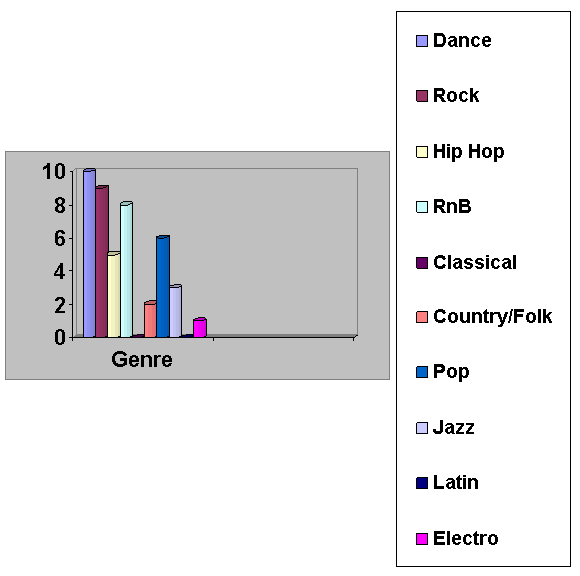
Survey Results - What genres of music do you enjoy?


This graph shows the results from my questionnaire on SurveyMonkey. These are the results for the question: 'What genres of music do you enjoy?'.

The results here were also quite spread. 'Dance' received the most votes closely followed by 'rock'. 'Hip Hop' and 'RnB' are two genres that could be merged in a magazine and therefore should also be considered as a highly sought-after option for my magazine.